Wednesday, 3 October 2018

FGM Mapathon at the United Nations

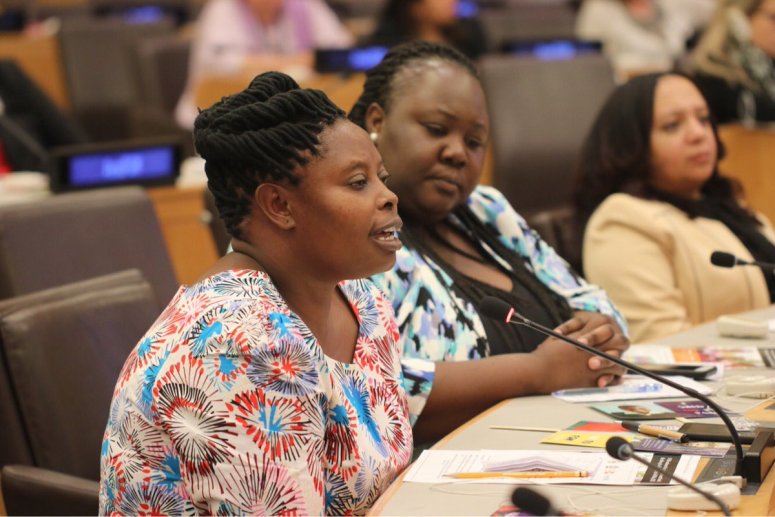
Last week Rhobi was invited to tell her story as an FGM survivor and activist at a high level panel as part of the United  Nations General Assembly in New York.  She spoke movingly about begging her parents not to cut her, as she feared dying and her body being thrown in the bush to be eaten by wild animals, as had happened to her friend Sabina.  But her pleas were in vain and she was cut and nearly bled to death.  She has since dedicated her life to saving other girls from a similar fate.
You can watch a recording of her testimony here.
The following day Rhobi participated in our mapathon at UNFPA where we explained how better maps can help activists like Rhobi quickly find girls at risk of FGM and showed people how they can help to create them.  There were side events in over 60 countries as part of this global FGM event, including at the Ministry of Women in Somalia, and with FGM activists in Kenya, Guinea, Mali, Niger, Uganda, Djibouti and many more.  Together they mapped over 49,000 buildings and almost 7000 km of roads to better protect girls at risk.
At UNFPA Tyler and Rebecca from HOT also explained how maps can be used for many humanitarian purposes.  You can see the presentation here. DoI0MZRU8AAfIJg
And now Rhobi is in London for the UK premiere of the film about her work, In the name of your daughter.  For those of you near London, Nottingham or Yorkshire I hope you may get the chance to watch it and to meet Rhobi.

Wednesday, 12 July 2017

First State of the Map in Africa

It was a great privilege to present Crowd2Map at the first State of the Map Africa held in Kampala last weekend.  Over 150 people came from 21 countries and I've never been to part of a conference that had such a strong sense of community. There can't be many places where people from such diverse backgrounds as Apple, the World Bank and Mapbox get to collaborate, dance and even play football with activists from Mali, Niger and Kenya, and community mappers from around the world.

The Map Uganda team did a great job - even down to the
amazing t-shirts, although they were no match for the Rest of the World football team that closed the conference.

My personal highlights were participating in the Women Mappers panel with these amazing women, meeting the other African Humanitarian OpenStreetMap Microgrant winners and learning about their projects, and even getting started with QGIS, Overpass Turbo and UMap thanks to the very many people who were extremely patient with a beginner like me.  And I was extremely impressed with the many Youthmappers from many countries, and hope they will support the chapter we have just set up at the Institute of Rural Development Planning in Tanzania.


Sunday, 19 February 2017

Drought brings hunger to Tanzania

Life in villages like Zeze in western Tanzania is precarious at the best of times.  People here are subsistence farmers living on around 80p a day and can only grow crops during the rainy seasons when they have access to water.  But now is not the best of times.

Climate Change is already having an impact here.  Ponds that used to supply water year round for animals (and often people too) have now started drying up.  The vuli rains were 6 weeks late in arriving here, inducing panic.  When the harvest fails, everyone goes hungry.

That is already happening in other areas of Tanzania.  In Kibirizi students walk for up to 4 hours a day to get to and from secondary school, on an empty stomach as there are no school lunches here.  When girls get home, they are expected to go to collect water and firewood and so have no time to study.  To try and help them overcome this disadvantage TDT helped the school set up a girls’ hostel nearby.  20 girls stayed there during the week, cooking and studying together by solar light each evening and then sleeping on the floor in one room when the lights ran out.  Their dedication is astounding.  They are determined to be the first in their families to go onto to further education and become
teachers, doctors, nurses.  In the exam results out last month they were on track to do this.  But now drought has come to Karagwe and their families have no food to send them.  The hostel is shut and all the girls have gone home.

In Maswa in Central Tanzania Kasedefo are running a successful microcredit scheme.  Women learn the basics about starting a small business and get a small loan and a mentor.  Over 200 women have succeeded.  Although their profits are modest by our standards, the effect is huge.  One woman told me now she could buy medicine for her sick baby, others can buy uniforms so their children can now attend school, and everyone took pride in their business and repaid their loans on time.

But this year’s rains have not come.  There is a shortage of water, crops are dying, people are going hungry and spending more and more time collecting water.  The women who proudly repaid instalments 3 months ago are now in tears.  Small businesses based of agriculture have no chance, and other fail because everyone is living hand to mouth with no money to spend. In times of desperation some people turn to a scapegoat.  Here that can be elderly women who can be accused of causing the drought by witchcraft.

Climate change is already affecting rainfall in places like Tanzania.  For people whose access to water is already precarious, that is life threatening. According to the Famine Early Warning System all of Tanzania now face critical food insecurity. Which is why in villages like Zeze, local youth drill by hand for 6 days through rock to reach water.  You can help them provide more vital bore holes here. 


Monday, 5 December 2016

Update from Zeze - WiFi, welding and a community library

Communicating with Zeze has been difficult - the mobile phone signal is generally poor, particularly in the rainy season and so Benedicto would have to go 40 km into Kasulu to send emails and Skype.  But in May 2016 Avanti, set up a pilot Community Hotspot in Zeze providing satellite broadband in the village, courtesy of a grant from the UK Space Agency.

This has meant that MVG are now able to communicate with the outside world.  They are monitoring climate change and water levels in a research project with Kings College, London, and can now email data without having to travel. They have also been able to download resources to teach the illiterate women starting to learn to read in the community library, as well as e-books for the children.

Unemployment is high in Zeze - there are very few opportunities other than the subsistence farming that is insufficient to provide an adequate income.  But when the schools need new desks they currently get carpenters in from Kasulu, as there are none with adequate tools or skills in Zeze.  So MVG is setting up a welding and carpentry workshop to train local youth and provide these services locally.  Getting equipment to a village 60km from a tarmac road and 40km from mains electricity is a slow process, particularly in the rainy season when everything turns to mud, but the workshop is built, the instructors in place and the youth identified, and excited to start learning in the New Year.

One of the issues with farming here is that soils are
depleted and farmers cannot afford good seeds or organic fertilisers. So MVG have set up a farmer training and loan scheme to help them.  The first 31 farmers planted their hybrid maize last week after great rejoicing that the rains had finally arrived, 2 months late. Another issue is access to water.  So far MVG have hand drilled 5 bore holes, including at the clinic, which did not have water.  This is a slow, hard, process, taking up to 6 days of hard physical labour for 7 men.  But it saves hours of walking to collect water for the villagers, and means they don't rely on the filthy ponds some of them resorted to previously.

They've got big plans to improve their community here, and money goes a very long way, so if you are able to donate it is very much appreciated and you can do so here. Asante!

Monday, 2 May 2016

Mapping the fight against FGM in Mara

As a survivor of FGM (Female Genital Mutilation) herself, Rhobi Samwelly is determined that the girls now growing up in Mara will not suffer as she did.  As a 13 year old she knew well the dangers of FGM, as one of her friends had died from the practice the previous year. She pleaded in vain with her parents not to subject her to it.  Having nowhere to turn she had no choice but to submit to the cut, which almost cost her her life as she bled so much she fell unconscious.

Twenty years later she finally achieved her dream and set up the Mugumu Safe House - a sanctuary where girls refusing FGM can turn during the annual "cutting season".  To ensure girls know they have a safe place to turn, Rhobi visits the remote villages where they are most at risk to tell them about their rights.  But there are no maps available meaning it is very hard to ensure all villages are covered. Villages like Sogoti were forgotten by the outside world. Rhobi had to cut down trees to reach it the first time she visited.  


Now we have added the school to Openstreetmap, but not yet the roads leading to it, making navigation still difficult.  

We want to ensure that girls in villages like Sogoti are protected from FGM and forced marriage.  Rhobi wants an activist in each village that girls at risk can turn to, and each of these places clearly labelled on a map, with a contact number.  Then girls in danger can more easily be directed to people who will help them, and be found easily by safe house staff.

We have started the map - please join us to complete it.and help protect girls like Javita.

There is more information about this mapping project and how much we have mapped here. 


Wednesday, 16 December 2015

161 girls now seeing sanctuary from FGM at the Safe House

Rhobi was expecting a relatively quiet cutting season this year as most of the Kuria tribe in Serengeti only cut on alternate years.  

But news of the Safe House has spread far and wide, and there are now 161 girls from as far away as Loliondo, 5 hours by bus.


Some of the girls are as young as 9.  Girls like Javita, left, fleeing with her sister.  Her mother told them to run, fearing that her neighbours would force them to be cut.  Javita is an amazing dancer, and wants to be a doctor, she told me shyly.

Others have come alone or with their friends. Many ran away at night after finding out that they were going to be cut in the morning. They arrive at the Safe House with just the clothes they are wearing.  

On Human Rights day last week the girls marched around Mugumu town demanding control over their bodies and singing songs they have composed proclaiming "We girls of today don't want FGM".


It's a struggle to
accommodate so many girls, especially as there is no kitchen and everything is cooked on firewood.  The girls eat outside which is difficult during the frequent rain.

Girls are now sharing 3 to a mattress and we've made a makeshift dormitory in the tailoring room.  But spirits are high - the girls know they are the lucky ones, many of their friends back in the villages are now dealing with the many health problems that come with being cut, including the very real danger of HIV infection.   You can see a short film about the Safe House here and one about Salama, the abandoned baby rescued from wild dogs that they are sheltering here. 

Sunday, 6 December 2015

Putting Zeze on the map

It's the rainy season in Zeze so everyone is busy in the fields making the most of the precious water to try and grow enough to sustain their families over the dry season. The unpredictability of the rainfall and lack of any storage is not without it's problems.  The roads quickly turn to inpassable mud and malaria rates soar.  


There is one minibus per day into town.  Otherwise if you need to go to the bank, hospital or council office you have to go by motorbike, which gets harder when it rains..


These 11 year old boys had cut grass for an hour and then carried it for a further hour, to sell it for the equivalent of 10p.


The womens' microfinance group is going very well with small loans continuing to transform lives.  I spoke to Deniza, getting a loan to expand her tailoring business.  Unable to walk, her life was transformed by her bicycle, but others are not so lucky.  Amos can only go to school if he crawls or someone carries him..


The secondary school laboratories now have roofs, but still no doors or windows.  I brought some simple science equipment such as springs and pH paper and so they excitedly did their first practical experiment - testing the pH of a local drink. Even the headteacher, a science graduate had never had access to indicator paper before. 

If you look for Zeze on Google maps you will just see a huge empty space where there are hundreds of villages. So, using Maps.Me a free app and donated tablets and phones we've been adding places of interest in Zeze and beyond to openstreetmap, the Wikipedia for maps that anyone can edit. 


Thank you to everyone who has contributed to our fundraising campaign.  We are using the money to purchase equipment for hand drilling and rope pumps, meaning we can dig water sources around the village for drinking and irrigation. If you would like to contribute you can do so here.   

Friday, 2 October 2015

Helping water problems in Zeze with an eBay pump..

Water dominates life in Zeze.  Everyone conserves the little they have as obtaining it is so difficult – carrying it long distances to your home, queuing at the pump…  There is also the continual fear that another of the pumps will fail, making water even harder to obtain.  These are constantly breaking down.  When I visited in June only 5 were working, on my most recent visit in August, only 3 were working. There have been times when the whole village of 8000 people are down to 1 working pump.
 Generally the problem is seals and bearings.   The local fundis (handymen) appear to be resourceful and show initiative, even to the extent of trying to make local parts where possible.  The water officials in Kasulu town 40 km away are less helpful, and frequently promise to help and visit but don’t.  They don’t stock any spare parts in Kasulu and say they order them from India when necessary.  One pump has been broken for over a year because pipes have broken off and fallen inside the well and there is  no equipment to get them out. 

So Benedicto and his friends decided to fix this hand pump with a solar one I bought on ebay, courtesy of a generous donor and brought out in my luggage.  As the water is so deep (36m down) we had to run it at 24V on two car batteries.  Getting these was a mission in itself.  You can buy very little in Zeze itself so a 
friend bought them in Kasulu and put them on a daladala (communal minibus) to drop them off at the junction 10km away where they were met by another 

friend with a motorbike.  Unfortunately when they arrived they were suspiciously light… because they were empty of the necessary acid, meaning we had to repeat the process the following day with bottles of acid..

We’d spent a long time negotiating with drivers in Kasulu to bring the 1000l plastic tank on their roof.  The first one in the village, this was a great novelty.  Benedicto tracked down the one man in Zeze with a saw and proceeded to make a wooden structure to put the tank on.
Getting the right seals to fix the pipes was another challenge.  I’d brought out all the seals I thought we would need and we bought the only jubilee clips we could find in Kasulu, but in the end had to tie things together with old car tyre strips.. 
But finally, by torchlight, the pump, dry for over a year, started pumping water, to great cheers and excitement.  The pump isn’t really powerful enough for this. It takes around 5 hours to fill the tank and it can’t keep up with the demand for water.  The long term plan is to raise enough money to buy a heavy duty pump capable of filling the 1,000,000l tank that has been out of use since the 1970s..


But, for now, the villagers are saved a long walk to a working pump… 

Thursday, 24 September 2015

Microfinance in Zeze - transforming womens' lives with small loans

In August I spent a week in Zeze village and met the chair, vice chair and secretary of the microfinance group, as well as many of the women who have received loans. 

I  also visited many of them in their homes and businesses and spoke to the Village Chairman, Village Executive Officer, and chair of MVG, who are running the scheme who all confirmed the positive impact the scheme is having on the village. 


Petronia had her loan in May, thanks to a new injection of funds from Wabia. She buys palm oil from farmers in the fields and resells it in the market, making approx. £8 profit per week.  Recently her 8 month baby started excreting blood and she was able to take her to the doctors and buy medicine.  Without her business she said she would have been unable to do that.

Pendo buys petrol in large containers and decants it into litre bottles which she sells in the market and on the road.  Her profits mean that she is able to pay for her son, who was unemployed, to study to be a mechanic.

Edita received her loan last month.  She is making bible covers for 80p that she sells for £1 in Kasulu, the town 40 km away that she visits twice a week.  She had sold 40 to a shop there the previous day.  She is saving to purchase a second sewing machine so her husband can also make them at the same time.  She also wants to branch into mpesa (mobile money) 

Josrene had an initial £18 loan which she repaid,  then a £50 loan in May.  She collects maize and beans from farmers in the field and then grinds flour and then sells in bulk to buyers from Kigoma.  She is saving to build a bigger house for her family with larger storage capacities as she wants to sell wholesale directly in Kigoma in the future.

Godliva had a second loan in June.  She also sells beans and maize, but also soap. She gets a profit of 80p  per box for this.  She is saving money to get a soap factory so she can make her own soap.  This would cost £120 but she estimates it would bring her "20 a week profit.
What was generally striking was the pride with which the women talked about their businesses.  They have noticeably grown in confidence since I met them in January, and have a higher status in their family and in the village as a whole. Originally I was told that there was resistance from some men in the village, concerned that women getting loans would be a threat to their authority.  

Now the same men ask Benedicto when their wives can get a loan.  It was touching to see a number of the women working closely with their husbands as partners in the business, whereas previously they worked much more separately. This appears to have had a positive effect on their relationships, which was confirmed by the women themselves. In the training women were told “Don’t use your loan to exploit your husband, rather money should be a tool for strengthening the love in your family”.   They seem to have taken this to heart!

Tuesday, 1 September 2015

Bringing broadband to Zeze School

School life in Zeze is rather different from the one I remember.  For a start most pupils walk for over an hour to get there.  They also have to carry water with them to clean the school  as there is no water source nearby.  Their parents are subsistence farmers who struggle to provide them with food and uniforms.  

There is no electricity in the village and kerosene is expensive, so they struggle to study after dark.  So Benedicto, TDT's enterprising local representative has set up student study groups.  Each group of 5 students was given one solar light, cost £4, which they share to study at night. Students are extremely ambitious.  They realise that doing well at school could be the only route out of poverty for themselves and their families. 

There are very few text books in the school, and none for research or further reading, so when I visited in June I brought a raspberry pi computer with downloaded content such as Wikipedia and Khan Academy videos on it.  As there is no electricity in the school they run this from a portable battery which they recharge in the headteacher's house which has solar panels.

But now Zeze has the opportunity to have a free satellite broadband installation, courtesy of funding from the UK Space Agency.  Very few of the students have ever left the village.  There are no female staff. The headteacher, Mr Mabhuye is very keen for the  girls to have successful role models to boost their confidence.  He is also keen to develop links with schools in the UK to expand their horizons and share ideas. 


However there is a catch.  They need to install solar power in the school by the end of September in order to order to benefit from this offer.  At a cost of £780 this is way beyond the scope of the school. If you would like to contribute to this project you can do so here.  All donations gratefully received. 

Wednesday, 1 July 2015

Bees and Sunflowers in Zeze


I was last with Benedicto in Zeze in January.  Then he was talking about his dream of constructing bee hives to improve incomes in Zeze village.
Now, thanks to many of you the hives are in place.  It hasn’t been without its challenges.  Moving the wood was delayed due to flooding during the rainy season, which also led to delays in the wood drying out sufficiently to make the hives, but last week the remaining hives were hung in the trees near the Moringa field, making 63 in total.  I’m glad I wasn’t here to witness this as it looked like a very precarious operation.


Already 12 hives are occupied by bees, and Benedicto is confident that by the end of July all the hives will be full, meaning they’ll be on track to harvest honey in October as planned.


In January a donor had given me £9 to give Benedicto, which he spent on Sunflower seeds.  These he planted during the rainy season and has just harvested more than 10 times as many.  

I (briefly) helped his father in shelling these, ready to press into oil to sell.

Benedicto never asks for money.  I asked him why, as the sunflowers had been so successful, he isn’t planting more now. He explained he can only grow them in the rainy season as his land is far from water sources so irrigation is impossible now.  When pressed on what he would need to do this he explains.  If he digs down 25m with a spade he can borrow from his neighbour, he could set up a solar pump to power a drip irrigation scheme. 

Such a system would transform agriculture here, and with help from generous donors he will start this in July...I've been promised avocados next time I visit.. 

Saturday, 27 June 2015

Christina, the circumciser turned anti FGM activist

I was last at the Safe House in early January, just after the cutting season had finished.  Most of the girls who had sought refuge then were slowly being reunited with their families.  Sophia, the social worker and Rhobi, were painstakingly negotiating affidavits with the parents, guaranteeing that they would not cut their daughters or marry them against their will. With thirty four girls the parents refused to cooperate and so they remained at the Safe House.  At that time these girls were very shy, and many visibly traumatised by their experience.

So it is heart-warming to be back in Mugumu to see what a difference 5 months has made.  There are now computer lessons in a room of 30 computers donated by a London school, and girls on the tailoring course are now selling items they have made in a shop on the premises.  Girls who have never had the chance to go to school can now read and write.  Their growth in confidence is astounding. 

On Tuesday the girls performed a song they had composed about FGM to over 500 people at an event for International Day of the African Child. 

Ten of the girls passed their primary education and so attend the local secondary school.  Their headmaster and teachers told me although they have missed a lot of education they are trying so hard they are sure they will catch up.  I set up a projector
and raspberry pi computer with content from World Possible in both the Safe House and the school so they can access Wikipedia and Khan Academy offline, giving them a huge range of educational content.  I also set installed 200 Swahili and English e-books from African Storybook.  These were a great hit for girls who have never had access to books, as were the Swahili audiobooks and maths cartoons from Ubongo.


Word games my sister in law donated like scrabble and Headbanz where players have to ask yes no questions to guess the card on their head caused great hilarity and enabled girls to practice their English in a fun way...


I also met Christina, a circumciser, who has previously cut girls in the local village of Kebanchabancha.  She witnessed the anti FGM road show Rhobi organised in her village and decided to stop cutting and publicly destroyed her tools.  This cost her dearly, she lost her source of income her husband divorced her, and she has had to move away from the village due to the pressure of people trying to persuade her to change her mind.  However she told me she did not regret her decision and now plans to become a peer educator helping persuade other circumcisers follow her lead.You can hear her story here.

So, the tide is turning..

But the Safe House still faces huge challenges.  Now it is known as a place of refuge, the local police bring people here who have nowhere else to go..  Lucy, an albino rape victim, Sophia and Veronica, two abandoned children and Msambo with her baby, beaten so badly by her husband that she lost 3 teeth.

It still needs a perimeter fence, to stop people wandering in, a dining hall and kitchen, and a car, so that girls in the villages can be reached, and there is not a repeat of the incident in December when the car broke down so 5 escaping girls were captured by their parents..

So, if you are able to help, everyone at the Safe House, and the girls at risk of FGM in Serengeti would be extremely grateful..

Sunday, 21 June 2015

A library on an SD card – for less than a fiver…


I met Omar in Itongoitale, a small village an hour out of Shinyanga.  He teaches Geography and History in the primary school here.

Itongolitale has no electricity and the only water supply is from ponds shared with cattle.  There is no mobile signal and only very occasional minibuses into town.  Some people have radios but batteries are scarce, only five people have solar.  So many people are entirely cut off from the outside world.  They rarely have the means to leave the village, and were not even aware of the Tanzanian election happening in October.  If there is a death, or other newsworthy event, in the next village, someone will walk the 15km to come and tell people face to face..

Malaria and water borne diseases are rife.  People don’t boil or treat their water and there has never been a deworming programme here.  I was told that the water was safe for them because they are used to it but it would be dangerous for me.

There are no computers in the village, and Omar has never used one.  But they teach IT in the school – by drawing pictures of keyboards and hard drives on the blackboard…

Omar told me he liked reading, so I asked him to show me his books.  He had three:  a Swahili/English dictionary, a photocopy of a university text book on African History, and a Geography text book for 13 year olds.  Yet Omar is very affluent by the standards of the village.  He has a smart phone which he uses when he goes into town each month to pick up his salary.  


I gave him a 16Gb sd card for his phone, with hundreds of ebooks in Swahili and English, plus health videos from Thare Machi on avoiding malaria and the need to boil drinking water. He promised to share this content in the school, and as we left he was proudly demonstrating it to a colleague..


A library on an SD card in a village without computers – cost:  less than £5..

Monday, 9 February 2015

Raspberry Pi in Masekelo

Bringing Wikipedia to a school without electricity

Masekelo secondary school in Shinyanga has many challenges: there's no electricity or water, so each pupil needs to collect 5 litres of water each day and carry it to school.  Until Tanzania Development Trust gave them a grant in November there were insufficient desks or chairs and many had to sit on the dirt floor.

The government has decreed that every secondary school must have science laboratories by the end of February.  No money was provided for this ; they should come from.parental contributions alone.  When your parents are subsistence farmers this is challenging.

The school has few text books or resources and a dire shortage of maths and science teachers,  but the dedication of its headteacher and staff now mean they have the best results of any government school in the district.

When I visited in September the dynamic headteacher,  Steve Mihambo,  told me of his dream of a computer room,  once they had power.

So I brought a Raspberry Pi computer, run from an external battery, with a 32gb SD card with content downloaded from WorldPossible.  This includes Wikipedia schools edition,  2000 maths and science videos from Khan academy,  800 classic books and various health resources.  A wifi stick in the Pi means any nearby smartphone, tablet or laptop can access all this content.


I demonstrated this to the teachers and school board on the 5 donated tablets I'd brought,  plus a couple of staff phones.  They were astounded.  "It's like a miracle", said the board chair.  "Now we are in the 21st century", added a teacher. 

You can follow the progress of this project, and the school in general, on their Facebook Page.


If you would like to know more,  or have an unneeded tablet or laptop you'd like to go to a good home,  please email me at j.chapman@tanzdevtrust.org